
Tenses
In order to get to grips with tenses, we will need to know how verbs work.
Remember: a verb is an ‘action‘ word, and tells the reader what is happening.
For example: ‘I buy fabric to make bags.’
However, the verb changes when we want to show that something is in the past, present or future tense.
Past tense
The past tense is used to show that something has already happened.
For most verbs, you add an ‘ed‘ on the end to make it past tense. If the word already ends in an ‘e‘, just add a ‘d‘!
For example:
‘Blink’ —> ‘I blinked‘
‘Cook’ —> ‘They cooked‘
‘Scream’ —> ‘He screamed‘
However, not all words follow this pattern:
- Not all past tense verbs have an ‘ed‘ or ‘d‘ ending, but have their own!
e.g. ‘blew‘ (from ‘blow’), ‘bought‘ (from ‘buy’), ‘did‘ (from ‘do)
- Use ‘was‘ for ‘I’, ‘she’, ‘he’ and ‘it’
e.g. ‘I was going…’
- Use ‘were‘ for ‘you’, ‘we’ and ‘they’
e.g. ‘We were going…’
- Some words don’t change at all, even in the past tense!
e.g. ‘cut’, ‘shut’, ‘spread’
Present tense
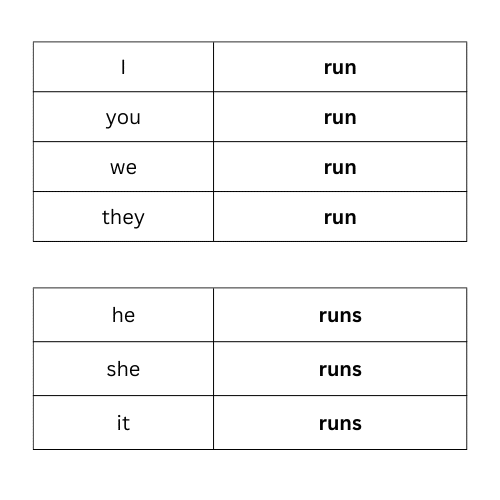
The present tense is used to show that something is currently happening.
The tables on the right show you how the verbs change depending on who is ‘doing‘ the verb. Most verbs follow this pattern:
- You don’t need to change the verb when using ‘I‘, ‘you‘, ‘we‘ or ‘they‘
- You need to add an ‘s‘ on the end of the verb when using ‘he‘, ‘she‘ or ‘it‘
Future tense
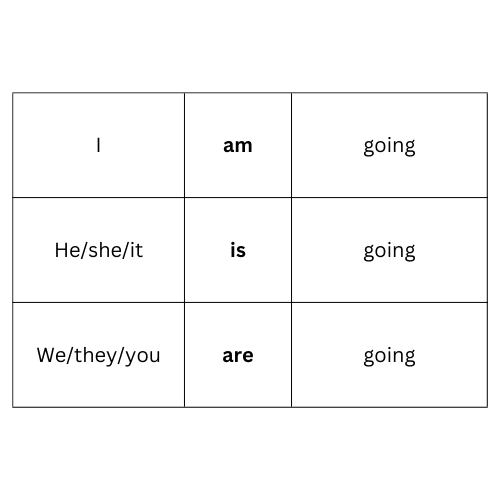
The future tense is used to show that something is going to happen. Take a look at the table on the right – notice how the verb ‘going‘ stays the same no matter who does it?
Let’s have a look at some sentences:
‘I am going to the cinema.’
‘It is going to rain.’
‘They are going to make a birthday cake.’
You can also use ‘will‘ to express the future tense! This is easier to remember, as the ‘will’ will never change.
For example:
‘I will go to the shop.’
‘He will go to the shop.’
‘We will go to the shop.’
As you can see here, the only thing that changes is who does the action (verb ‘go‘).