
Functional Skills: Mean, Median, Mode and Range
Mean, Median, Mode and Range
The mean, median and the mode are different measures of the average value of a data set. The range is a measure of spread.
There are 5 skills you need to learn.
Skill 1: Finding the Mean
Whenever people talk about an average value, they are usually referring to the mean. To calculate the mean, we need to add up all the values and divide by the number of values:
Note: the mean is affected by outliers – values that lie far outside the rest of the data.
Follow Our Socials


Follow our Facebook for community support



Follow our Instagram & TikTok for revision help
Our Facebook page can put you in touch with other students of your course for revision and community support. Alternatively, you can find us on Instagram or TikTok where we're always sharing revision tips for all our courses.
Follow our socials for revision tips and community support
Skill 2: Finding the Median
The median is the ‘middle value’ of a data set. In order to find the median, we first have to put the data in order of size. There are then two methods we can use:
- Cross out the first and last values, then the second and second last values and so on. Eventually we will be left with one or two numbers, depending on whether we had an odd or even number of values to begin with. If only one value is left, this is the median; if two values are left, the median is halfway between the two.
- Let the number of values we have to begin with be . We can calculate the position of the median value using the formula:
Whatever number the formula gives, we count that number along the list of values. If the formula gives us a decimal, e.g. , the median is half-way between the tenth and eleventh values.
Skill 3: Finding the Mode
The mode is the most frequent value in a data set. Finding the most is simple – just look for the value that occurs the most often.
Note: it is possible to have more than one mode or no mode at all if there are no repeated values.
Skill 4: Finding the Range
Unlike the mean, median and mode, the range is not a type of average. The range is a measure of spread – it tells us how spread out our data is. To find the range, we subtract the smallest value from the largest value:
Skill 5: Using Averages to make Predictions
You can use averages to make estimates and predictions. You have to make assumptions when making predictions.
Example: Jordan spends on food in January, on food in August and on food in November.
Calculate the mean to estimate how much Jordan spends on food in one year.
Calculate the mean by adding up the values and dividing by :
mean
Now, assume that Jordan spends each month.
Then, an estimate for the total amount of money Jordan spends on food in one year is:
Example 1: Finding the Mean and Range
Ryan measures his height and the height of six of his friends. Their heights in cm are:
Find the mean and range in their heights.
[2 marks]
First to find the mean, we need to add up the values and divide by the number of values, which is :
cm
The range is the difference between the largest and smallest value:
cm

Example 2: Finding the Median and Mode
Ryan measures his height and the height of six of his friends. Their heights in cm are:
Find the median and mode in their heights.
[2 marks]
First to find the median, we need to put the heights in order:
We will cross out the first and last values, then the second and second last values, and so on, working inwards:
So the median is cm.
The mode is the most frequent value. There is only one value that appears twice, so the mode is cm
Functional Skills: Mean, Median, Mode and Range Example Questions
Question 1: Calculate the mean of the following numbers:
[2 marks]
To calculate the mean, add up all the numbers and divide by the number of values:
Question 2: Calculate the median of the following numbers:
[2 marks]
First, we need to put the numbers in order:
Crossing out the numbers on the end and working inwards leaves us with:
The median is halfway between and .
We can calculate the median by:
Question 3: Calculate the mode of the following numbers:
[1 mark]
The mode is the most common value, which in this case is
Question 4: Calculate the range in the following numbers:
[1 mark]
The range is the difference between the largest and smallest values.
Question 5: Mr Ding is a worker. In March, he has sick days. In October, he has sick day. In November, he has sick days. In December, he has sick days.
Calculate the median, and use this to estimate how many sick days he has in a year.
[2 marks]
To calculate the median, first put the numbers in order:
There are two middle values, so the median is half way between these values:
median
Now, assume that Mr Ding has sick days each month.
Therefore, an estimate for the number of sick days Mr Ding has is:
sick days
Specification Points Covered
L1.29 – Find the mean and range of a set of quantities
L2.23 – Calculate the median and mode of a set of quantities
Functional Skills: Mean, Median, Mode and Range Worksheet and Example Questions

Mean and Range L1
FS Level 1NewOfficial PFS
Mean, Median, Mode and Range L2
FS Level 2NewOfficial PFSRevision Products
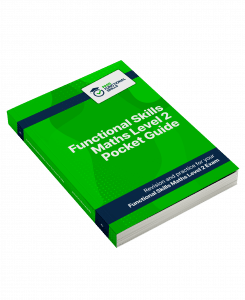
Functional Skills Maths Level 2 Book
Revise and practice for your functional skills maths level 2 exam. All topics covered in this compact functional skills maths revision guide book.
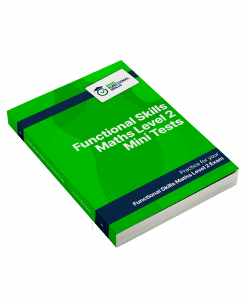
Functional Skills Maths Level 2 Mini Tests
Practice for your functional skills Maths level 2, questions from every topic included.
Functional Skills Maths Level 2 Revision Cards
Revise for functional skills maths level 2 easily and whenever and wherever you need. Covering all the topics, with revision, questions and answers for every topic.
Functional Skills Maths Level 2 Practice Papers
This 5 set of Functional Skills Maths Level 2 practice papers are a great way to revise for your Functional Skills Maths Level 2 exam. These practice papers have been specially tailored to match the format, structure, and question types used by each of the main exam boards for functional skills Maths. Each of the 5 papers also comes with a comprehensive mark scheme, so you can see how well you did, and identify areas to improve on.
Functional Skills Maths Level 2 Practice Papers & Revision Cards
This great value bundle enables you to get 5 functional skills maths level 2 practice papers along with the increasingly popular flashcard set that covers the level 2 content in quick fire format.