
Functional Skills: Time
Time
Time is a measurement used in everyday life.
Units of Time
As you may know, time has a variety of different units. You will need to be able to change between them.
Here is a list of different units of time and how they are related:
- seconds minute
- minutes hour
- We can divide hour like this:
- minutes hour
- minutes hour
- minutes hour
- hours day
- days week
- days year
- months year
- years decade
- years century
-hour clock vs -hour clock
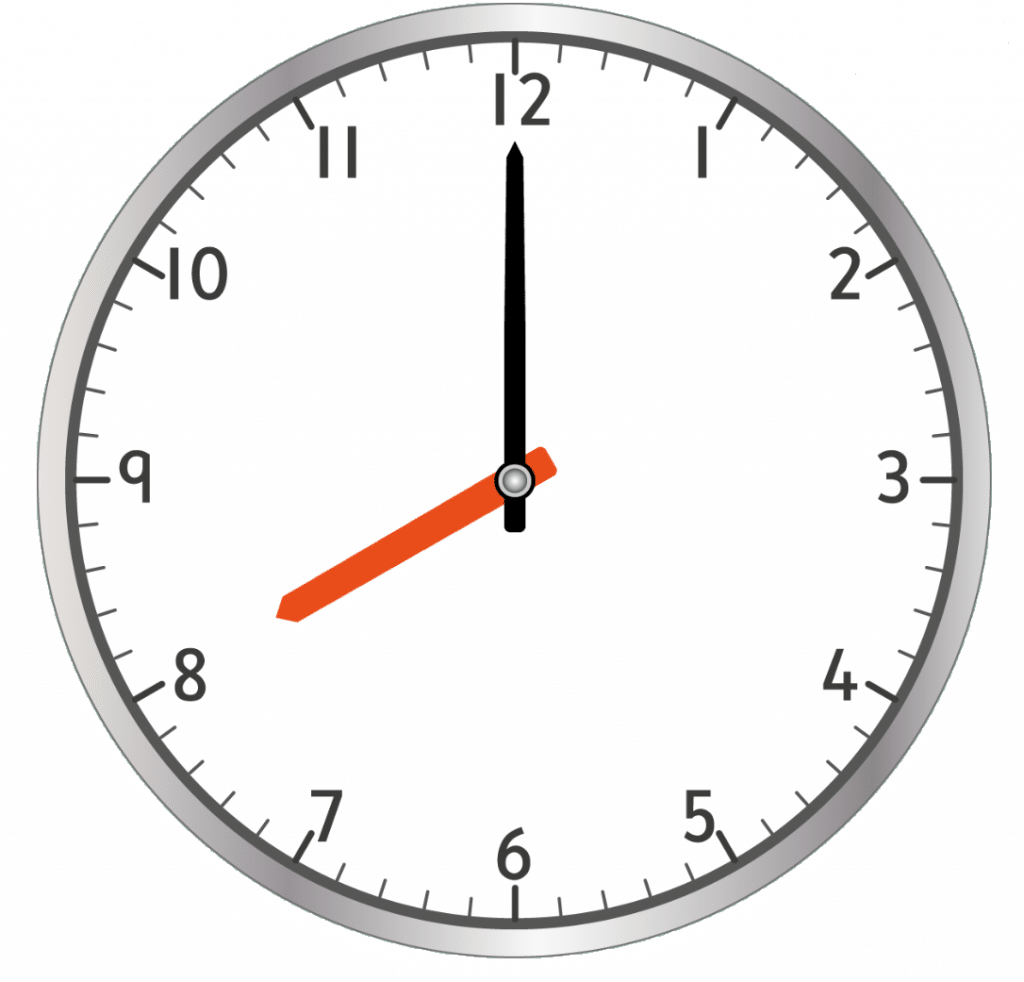
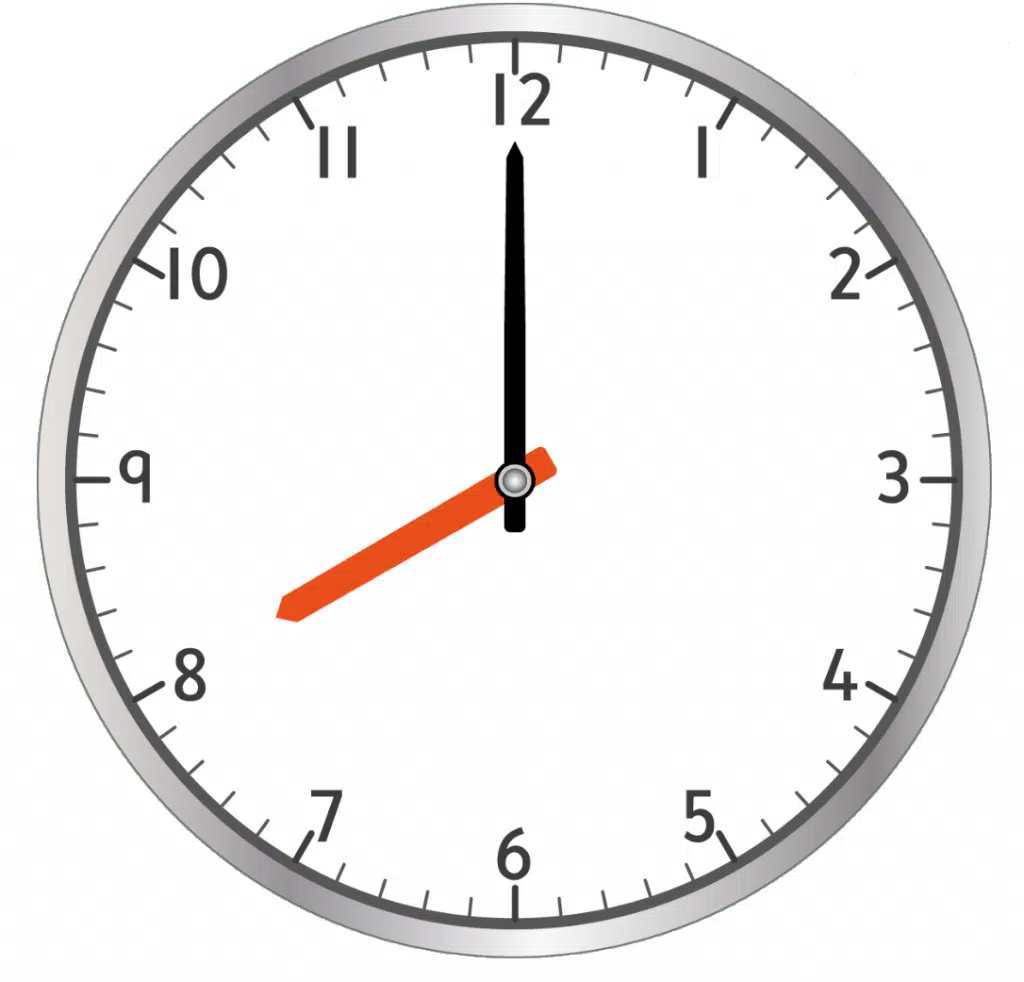
The time of day can be given using a -hour clock or a -hour clock.
The -hour clock goes from am to am and then pm to pm.
For example, am is o’clock in the morning and pm is o’clock in the evening.
The -hour clock goes from to
For example, is half past in the morning, and is half past in the evening.
To go between afternoon times from the -hour clock to the -hour clock, you need to add hours. To go the other way, you subtract hours from the -hour clock.
Follow Our Socials


Follow our Facebook for community support


Follow our Instagram & TikTok for revision help
Our Facebook page can put you in touch with other students of your course for revision and community support. Alternatively, you can find us on Instagram or TikTok where we're always sharing revision tips for all our courses.
Follow our socials for revision tips and community support

Digital Clocks
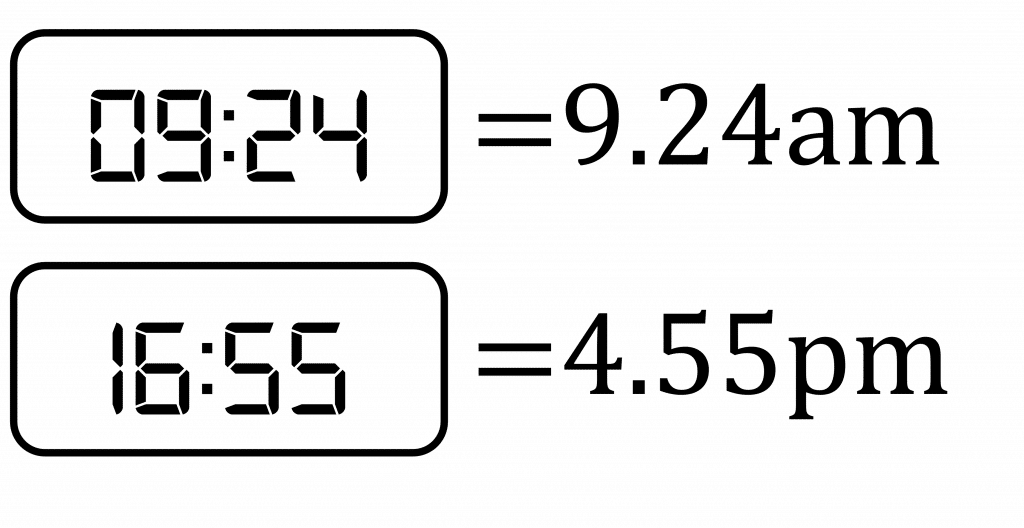
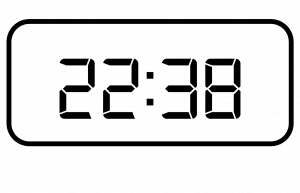
Reading time on a digital clock is simple: the first two digits show the hour, then a colon separates the hours and minutes, then the second two digits show the minutes.
Digital clocks use hour time, so it is important to know how to interpret that to read a digital clock.
Analogue Clocks
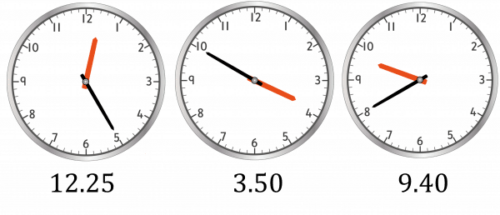
On an analogue clock, the small hand points to the hour while the big hand points to the minute. However, it is not as simple as reading off times in either case.
1. For the big hand, because there are only numbers on an analogue clock, each number represents minutes, not minute. So when the big hand points to , it is minutes past the hour because . If the minute hand is between numbers, this represents being between increments of minutes.
Note: If the big hand points to , this does not mean it is minutes past, it means it is on the hour.
2. For the small hand, it will usually be between numbers. If it is between and , then the hour is and it gets closer to . Since there are only numbers, the hour can only go up to , so analogue clocks are not hour.
Working Out Times
The best way to work out times is to split it into chunks. This comes in two styles:
- Working out how long something takes.
- Working out what time it will be once something has happened.
Example: Jack sets off for work at am and arrives at am. How long does his journey take him?
Split this into chunks. First, to go from am to am is minutes. Then to go from am to am is hour. Then to go from am to am is minutes.
Now, add the hours and the minutes separately.
We have hour, and we have minutes, so our total time is hour minutes.
Example: The train from Harrogate to York takes minutes. If it leaves Harrogate at , what time does it arrive into York?
Again, split this into chunks. to is minutes, so there are minutes left.
minutes after is , which is when the train gets into York.

Timetables
Timetables have rows and columns. Rows are horizontal and columns are vertical.
You need to know how to read several different types of timetables.
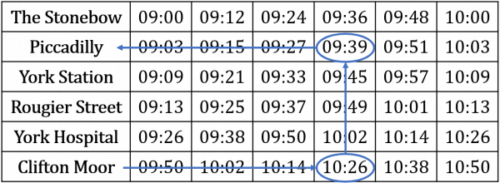
Bus timetables list in each column the times an individual bus gets to each stop. So to find the bus you need to get to arrive at a certain time you have to:
Step 1: Find the stop you want.
Step 2: Go along that row to find the last one before the certain time.
Step 3: Find the time that bus gets to the stop you want to get on at.
Example: Chloe wants to arrive at Clifton Moor by . She will get on the bus at Piccadilly. At what time does she need to be at Piccadilly bus stop?
Follow along the Clifton Moor row to find a time before – in this case it is .
Now, follow this column up to Piccadilly – the stop Chloe is getting on at. This gives a time of , which is when the bus she needs to be on leaves Piccadilly.
Hence, she must be at the Piccadilly bus stop by .
Some other types of timetable are much easier to read than bus timetables. To find out when an event takes place, simply look to the row and column headings for the row and column it is in.
Example: Fatima is going to an education conference. She is planning which sessions she wants to attend. She has a networking event running at the same time to the conference that is at pm on Saturday. Which session would she not be able to attend?
We need to look at the pm row and the Saturday column. Where these intersect is the event that Fatima will not be able to attend. This event is “Key Stage 2: Does the Curriculum Need and Overhaul?”

Calendars
Calendars show dates. Normally, each page of a calendar shows a grid that will represent a month. The days of the week will be listed along the top, then each square will have a number in which corresponds to that day of the month. Each square in a calendar can also contain information relating to that day. Questions on calendars are about being able to interpret this information.
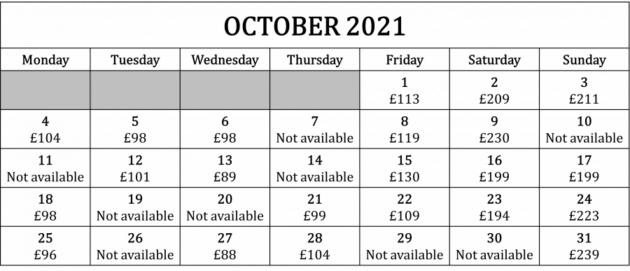
Example: Jurgen has been in Germany since April and wishes to fly back to the United Kingdom in October. He will be flying from Berlin Brandenburg Airport into London Heathrow Airport. The calendar below shows the prices of flights from Brandenburg to Heathrow on each day. Jurgen wishes to fly between th and th October, and he wishes to spend the least money possible on flights. Which day should he choose?
The calendar shows us that no flights are available at all on th October and th October. This leaves Jurgen with th October, where flights cost , th October, where flights cost , and th October, where flights cost . The smallest cost out of these is on th October. So Jurgen should travel on th October.
Functional Skills: Time Example Questions
Question 1: How many minutes is seconds?
[1 mark]
There are seconds in minute.
minutes
Question 2: Change the following times from the -hour clock to the -hour clock:
a) pm
b) pm
Change the following times from -hour clock to the -hour clock:
c)
d)
[4 marks]
a) and b) are both afternoon times, so add hours to both:
a) pm
b) pm
c) and d) are also afternoon times, so subtract hours from both:
c) pm
d) pm
Question 3: Georgia needs to catch the bus to get to work on time. It takes her minutes to walk to the bus stop from her house. If she sets off at pm, will she get to the bus stop on time?
[2 marks]
pm is using a -hour clock. If she sets off at , she will get to the bus stop at , so she won’t get to the bus stop on time.
Question 4: What times are being shown on these clocks? Give your answers in 12-hour format.
a)
b)
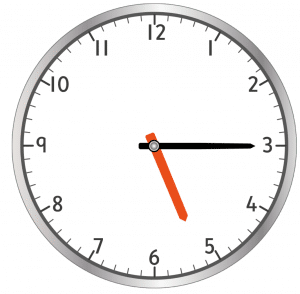
[2 marks]
a) pm
b) pm
Question 5: Tony has joined the overnight spooky tour of York to take place on Halloween night. He is given the following timetable for it.
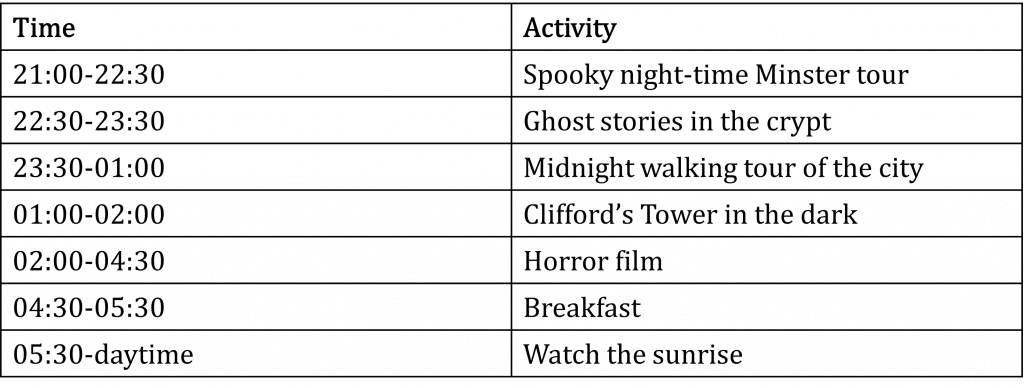
a) Over what time does the midnight walk take place?
b) How long does the horror film last?
[2 marks]
a)
b) hours minutes
Question 6: Brainbender escape rooms prices vary by day based on demand. Ruth and Stephen are looking to book an escape room on a weekend in December, and they want to pay as little as possible. Which day should they choose?
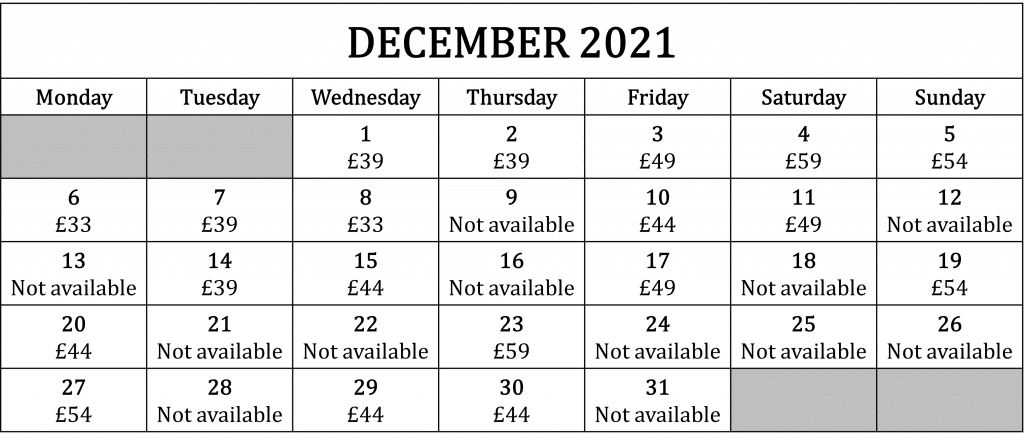
[3 marks]
The available weekend days are Saturday th December, for , Sunday th December, for , Saturday th December, for , and Sunday th December, for .
The cheapest of these is Saturday th December, for , so they should choose this date.
Specification Points Covered
EL3.12 – Read, measure and record time using am and pm
EL3.13 – Read time from analogue and 24 hour digital clocks in hours and minutes
L1.20 – Convert between units of length, weight, capacity, money and time, in the same system
Functional Skills: Time Worksheet and Example Questions

Time EL3
Entry Level 3NewOfficial PFS