
Functional Skills: Angles and Bearings
Angles and Bearings
In this section we will look at the basics of angles and bearings.

What Are Angles?
Angles are measured in degrees ().
There are used in shapes and inform you how far something has turned from a fixed point.
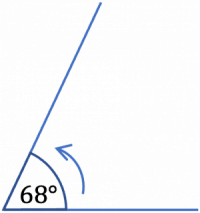
The diagram above shows the diagonal line has turned from the horizontal line.
Angles are called different names depending on their size:
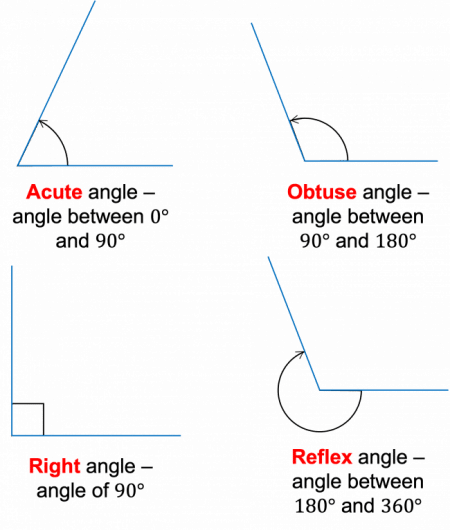
Note: Angles can be measured clockwise or anticlockwise.
Measuring Angles
To measure angles between lines you can use a protractor.
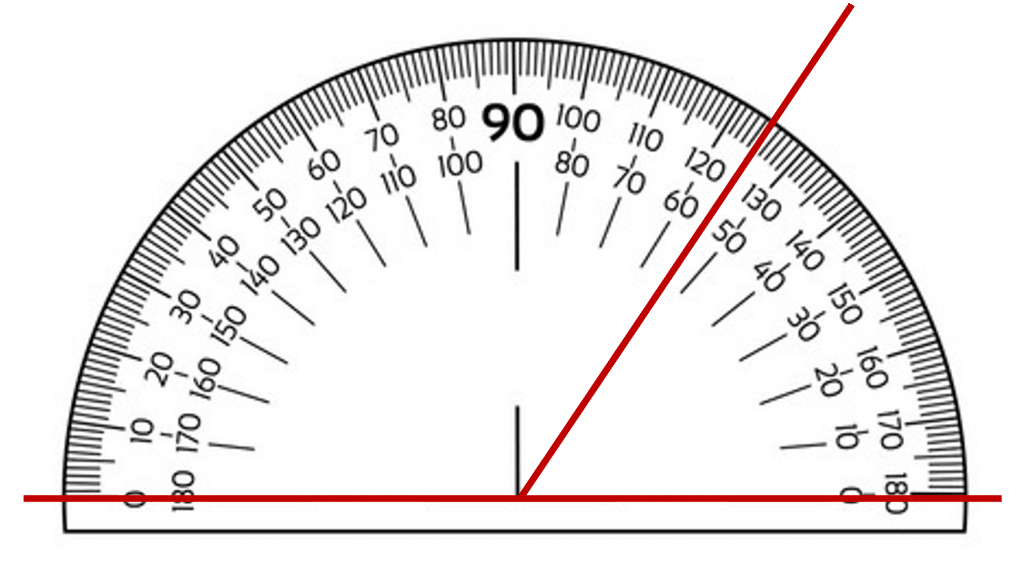

Step 1: First centre the protractor with the fixed point where the lines meet.
Step 2: Then line up the bottom line of the protractor with one of the lines.
Step 3: Read off the protractor – we can see that this acute angle is or if you measure the obtuse angle.

Follow Our Socials


Follow our Facebook for community support



Follow our Instagram & TikTok for revision help
Our Facebook page can put you in touch with other students of your course for revision and community support. Alternatively, you can find us on Instagram or TikTok where we're always sharing revision tips for all our courses.
Follow our socials for revision tips and community support
Bearings
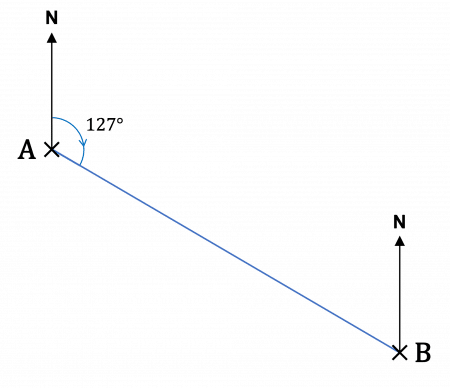
Bearings denote the direction of one point to another, given as angles in degrees.
They are always measured clockwise from the North line and are written as three digits, for instance if the angle is , then you write
Example: The bearing of from is
Functional Skills: Angles and Bearings Example Questions
Question 1: Use a protractor to find the angle labelled .
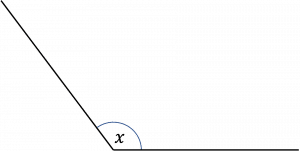
[1 mark]
Using a protractor we can see that the angle is .
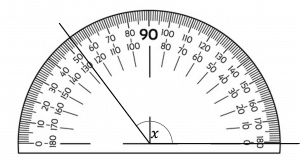
Don’t worry if you didn’t get exactly, usually you will be given a margin of error, so you would still be correct if you measured it as or .
Question 2: Using a protractor, find the bearing of from .
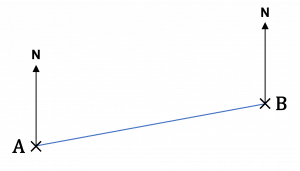
[1 mark]
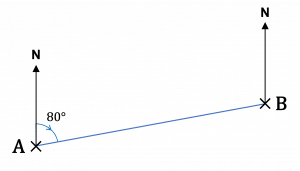
The angle between the North line and the line starting from to is . So, the bearing of from is .
Question 3: State whether the following angles are acute, obtuse, reflex or a right angle:
a)
b)
c)
d)
[4 marks]
a) is an obtuse angle because it is between and .
b) is an acute angle because it is between and .
c) is a right angle.
d) is a reflex angle because it is between and .
Specification Points Covered
L1.24 – Draw 2-D shapes and demonstrate an understanding of line symmetry and knowledge of the relative size of angles
L1.26 – Use angles when describing position and direction, and measure angles in degrees
Functional Skills: Angles and Bearings Worksheet and Example Questions
