
Functional Skills: Unit Conversions
Units
All measurements need units, whether that’s length, weight or capacity. There are two main types of units, metric and imperial. You will also encounter other units. You will need to be able to convert between units to solve calculations.

Common Units
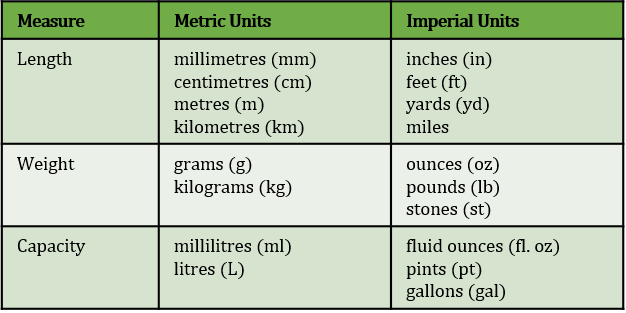
The table below shows some common metric and imperial units for length, weight and capacity. The length of something is how long it is. The weight of something is how heavy it is. The capacity of something is how much it can hold.
Metric and Imperial Unit Conversions
You will need to know the conversion factor to go between metric and imperial units, to then multiply or divide by this value to convert the unit.
The tables below show some common metric and imperial unit conversions. You only need to memorise the metric conversions, if you have to convert imperial units you’ll be told the conversion factor.
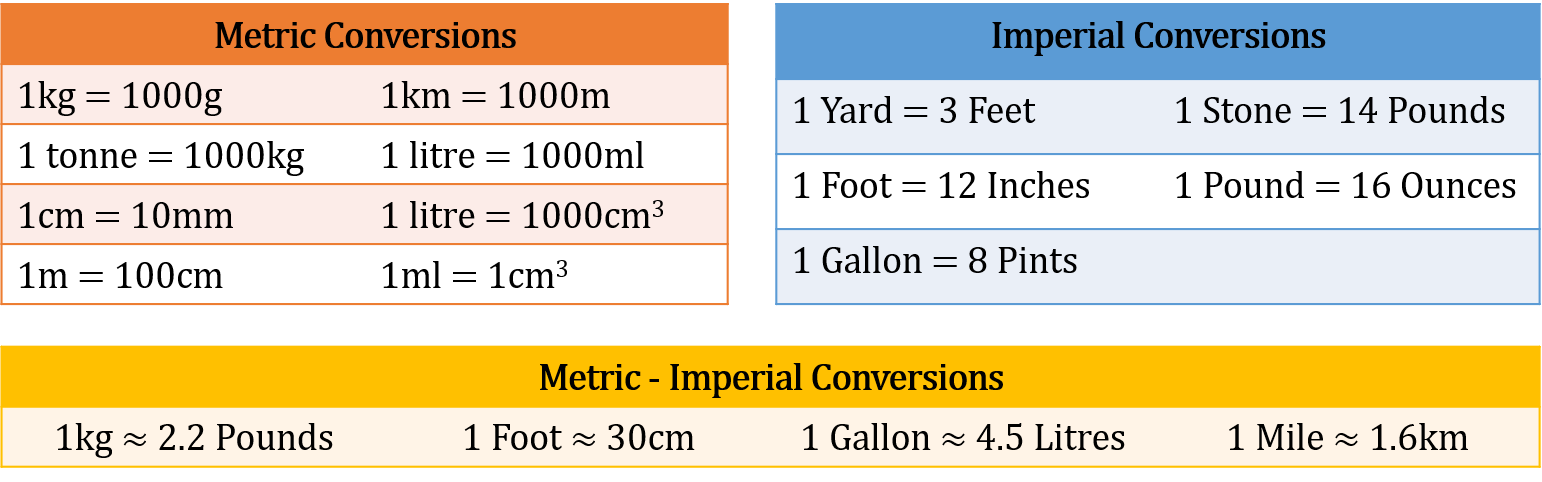
You can convert between any units as long as you are given (or know) the conversion factor.
Follow Our Socials


Follow our Facebook for community support



Follow our Instagram & TikTok for revision help
Our Facebook page can put you in touch with other students of your course for revision and community support. Alternatively, you can find us on Instagram or TikTok where we're always sharing revision tips for all our courses.
Follow our socials for revision tips and community support
Unit Conversions – Metric and Money
Converting Metric units is very simple, all we need to do is multiply or divide similar units by a conversion factor.
Example: Converting from to and vice versa:
Example: Converting from Pounds (£) to pence (p) and vice versa:
p
p
Unit Conversions – Volume
There are different ways the units of volume can be written:
You may be given questions where you have to convert between these, but you will be given these in the question.
Example 1: Metric to Imperial Conversion
Frazer buys a bag of soil for his garden that has a mass of kg. What is the mass of the bag of soil in pounds to decimal place?
Use the conversion rate pound .
[2 marks]
To convert from kilograms to pounds we need to divide by
pounds ( decimal place)
Example 2: Money Conversion
Sanjay paid for a hotel stay. How much is this in pounds ()?
[1 mark]
So, Sanjay paid for the hotel stay.
Example 3: Volume Conversion
Shavaughn has a measuring cylinder with a capacity of cm. She pours water into the cylinder, and stops when the water takes up half of the measuring cylinder’s capacity.
What volume of water did Shavaughn pour into the measuring cylinder? Give your answer in millilitres.
Use cm ml
[2 marks]
cm
cm ml
Functional Skills: Unit Conversions Example Questions
Question 1: Kerry is going on holiday to Spain and needs to convert into euros. There is a fee for converting the currency.
Using the conversion rate: , calculate how many euros she will be able to take on holiday.
[2 marks]
We can either deduct the commission from the amount in pounds at the start or from the amount in euros at the end.
A decrease means she will have of her money left over, so
Using the conversion rate given in the question, we can find out how much is in euros.
Question 2: Meghan goes on a kilometre walk with her dog. What is the distance of Meghan’s walk in feet, to the nearest foot?
Use the conversion rate: .
[2 marks]
The conversion rate is between metres and feet, so first we need to convert km into metres. We know that km is m, so:
If foot is equal to metres, that means we would have to multiply a distance in feet by in order to get the equivalent distance in metres. So, to go from metres to feet, we will have to divide by . This means Meghan’s walk in feet is:
(to nearest foot)}
Question 3: Declan has bought a container that measures . What is the volume of his container in litres?
m L
[3 marks]
Converting the measurements from cm to m first:
cm = m
cm = m
cm = m
Then calculate the volume of the container in m:
m
Finally, convert to litres:
m L
Question 4: A runner runs at an average pace of minutes and seconds per kilometre during a mile race. Calculate how long will it take the runner to complete the race. Give your answer in hours and minutes, rounding your answer to the nearest minute.
Use the conversion rate:
[3 marks]
We first need to convert the distance of the race from miles to kilometres, as the average pace has been given in minutes per kilometre. We can convert miles into kilometres as follows:
If it takes the runner minutes and seconds to run one kilometre, then we simply need to multiply kilometres by the runner’s pace.
(Remember that seconds is a minute = minutes)
The total time to complete the 10 mile race at a pace of minutes per kilometre is therefore:
The question says that we can round the answer to the nearest minute, so the half marathon will take minutes, which is hour and minutes.
Question 5: In January a businessman buys of dollars. He then trades back to pounds in February. To the nearest pound, what profit has the businessman made?
January exchange rate:
February exchange rate:
[2 marks]
If the businessman exchanges into dollars in January, we need to calculate how many dollars he receives. If equates to , then can be converted as follows:
If he trades the back into pounds in February, we need to calculate how many pounds he will receive. The exchange rate is to the pound, so we need to see how many times goes into :
(to the nearest pound).
If the businessman started with and ended up with , he has made a profit of .
Specification Points Covered
L2.14 – Convert between metric and imperial units of length, weight and capacity using a) a conversion factor and b) a conversion graph
Functional Skills: Unit Conversions Worksheet and Example Questions

Unit Conversions L2
FS Level 2NewOfficial PFSRevision Products
Functional Skills Maths Level 2 Book
Revise and practice for your functional skills maths level 2 exam. All topics covered in this compact functional skills maths revision guide book.
Functional Skills Maths Level 2 Mini Tests
Practice for your functional skills Maths level 2, questions from every topic included.
Functional Skills Maths Level 2 Revision Cards
Revise for functional skills maths level 2 easily and whenever and wherever you need. Covering all the topics, with revision, questions and answers for every topic.
Functional Skills Maths Level 2 Practice Papers
This 5 set of Functional Skills Maths Level 2 practice papers are a great way to revise for your Functional Skills Maths Level 2 exam. These practice papers have been specially tailored to match the format, structure, and question types used by each of the main exam boards for functional skills Maths. Each of the 5 papers also comes with a comprehensive mark scheme, so you can see how well you did, and identify areas to improve on.
Functional Skills Maths Level 2 Practice Papers & Revision Cards
This great value bundle enables you to get 5 functional skills maths level 2 practice papers along with the increasingly popular flashcard set that covers the level 2 content in quick fire format.